To understand the journey that began at Dom zu Speyer in December 1076, to understand the conflict between King Henry IV and Pope Gregory VII that led to Gang nach Canossa, the Walk to Canossa, l'umiliazione di Canossa, to that image so ripe with contradictory meanings--a king kneeling in the snow--you really have to go back a generation, to an earlier Henry and an earlier Gregory, to the year 1046, when Henry III, King of the Romans--which means a king of the Germans who hasn't yet been anointed as Holy Roman Emperor--came down to Italy to clean up a mess.
 In 1046 there were three popes, all with sordid back stories, even Gregory VI, the supposed reform pope, who had actually purchased the papacy from one of the other popes who wanted to get married, but then the chick dumped him so the dude decided he wanted to keep his old job, and meanwhile the other guy, etc., etc....
A real mess, disgusting even, so Henry III deposed all three of them and picked a new pope, his own personal confessor in fact, a fellow German, who took the name Clement II and promptly christened Henry as Holy Roman Emperor and for good measure gave him the title of Patricius, which basically meant he had the right to appoint popes, which was a big deal to Henry, for while it was obvious to everyone that he had the power to appoint popes, Henry III was as devout as he was power-hungry, and he wanted the right.
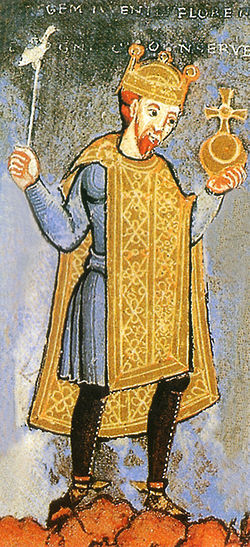 Needless to say this display of imperial prerogative pissed off a lot of people in Italy, oh for example the people in the reform movement, the backers of the now-deposed Gregory VI, and one reformer in particular, an ambitious monk named Hildebrand, a blacksmith's son from a small town, who had risen from his humble origins by brilliance and hard work to become Gregory's chaplain and the toughest ecclesiastical operative in Rome. Of course some people say he wasn't a blacksmith's son at all, but Gregory's nephew, part of the same rich half-Jewish Roman family, one of the two leading families of Rome. Now the anti-semitism of the time wasn't racial or particularly virulent--once you converted you and your descendants were pretty much okay--so the problem with Hildebrand's family, if it was his family, wasn't its Jewishness but its richness--so maybe Hildebrand made up the blacksmith story after his uncle got bounced out of the pope job for acting too rich, too entitled--or maybe he actually was a smart hard-working poor kid--but one thing is clear, Hildebrand was the kind of reformer who would have fit right in with la politica di Chicago, if the earth had remained habitable long enough for Chicago to have earned una certa fama di corruzione.
Hildebrand's reform movement, and it was his movement, the Gregorian Reform, though neither he nor the movement yet had that name, they wanted to make the Catholic church holy and clean and pure, and they focused, his reformers, on two main areas: money and sex. First, they wanted to stop the sin of simony, the buying and selling of church offices, especially when the profits went to some secular nobleman, not the church, and second, they wanted to stop the clergy from having sex, any sex, all sex, period, whether that meant the local parish priest taking his housekeeper to his bed as a common-law wife, pretty much standard practice at the time, or novices in a monastery humping and sucking each other, it all had to stop, no excuses, no exceptions, sorry my son, that includes jerking off. 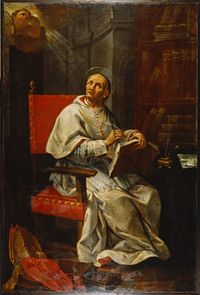 Now for some of the reformers, like Peter Damian, an abstinence-only sex-negative fanatic, this purity was an end in itself, but a practical guy like Hildebrand could clearly see how these reforms could be very used to strengthen the power of the church: priests would be answerable only to bishops, bishops to Rome, Rome to the Pope, with no side obligations to some feudal ruler, and as for sex, of whatever variety, it too created divided loyalties, interrupted the flow of authority, and threatened the proper transmission of church property from generation to generation, the last thing the church needed was for priests to start leaving their land to their bastards.
So Hildebrand's reformers had a problem. How could they tell some local nobleman that he couldn't appoint his own parish priests, when the emperor was hand-picking popes whenever he felt like it? They got lucky in 1056 when Henry III died unexpectedly, or maybe not so unexpectedly, he wasn't yet 40 years old, but for the last few years he had been concerned less with building his empire than passing it on to his his young son, so maybe Henry III had seen, or felt, something coming, anyway the next Henry, the six-year-old Henry IV, who had actually been co-king since he was three, took over sole possession of the throne in 1056 with his pious mother, Agnes of Pitou, as regent, and it wasn't only the dukes and counts of Germany who began to circle the minority like vultures, nibbling at the edges of the boy-king's power, it was Hildebrand in Rome who made the boldest move of all.
By this time Hildebrand was the archdeacon of the church, popes came and went but Hildebrand did all the work and in his own way took all the credit, at a church council in Rome in 1059, he got the bishops to issue a document called In Nomine Domini, which took the job of selecting a pope away from all secular leaders and gave it to the College of Cardinals, starting a tradition that would have continued to the present day if the world had not ended in 1079.
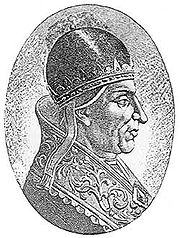 And in 1073, at the funeral mass of Alexander II, the ecstatic faithful, or a drunken mob, or a gang of hired mercenaries, take your pick, started chanting Hildebrand's name and it became pretty clear to to everyone in the church and in the neighborhood that Hildebrand had been chosen to be the new Pope, which was not exactly the procedure set forth in In Nomine Domini, but Hildebrand did make sure, before he took the chair of St. Peter, that he got himself ordained as a priest, and that the College of Cardinals rubber-stamped his election, and so he ascended the throne as Gregory, and not just any Gregory but Gregory VII, the very number of his name a challenge to that annoying German king whose father had tried to tell the world that Gregory VI had never been a pope at all, what a way to redeem the name of your uncle, or your former employer, or your mentor, whatever, and at the same time stick it to your biggest rival.
Henry got the message.
Next in Main Story:
Speyer: First Passengers
Next in Historical Background:
Henry Fires Gregory


